 Transit Now
The side streets were there all along
How quiet routes changed the way I ride Bike Share Toronto.

Bike Share Toronto is how I get around downtown. Grab a bike, ride, dock it, walk away. No lock, no bike of my own to worry about.
The riding part, I loved. The route part, not so much.
Every directions app I tried wanted the same thing: the fastest line between two points. Downtown, that line is almost always a big street. Buses pulling in and out beside you. Streetcar tracks waiting to catch a wheel. A row of parked cars, any one of which could open a door. Cars squeezing past with a few inches to spare.
I rode it anyway. But I rode it tense. Shoulders up, eyes everywhere, counting blocks until the trip was over.
And some trips, I didn't ride at all. If the route looked bad, I took the TTC instead. Sometimes I just didn't go.
The calm street one block over
Then I started noticing something. Right beside the busy streets, there were quiet ones. Residential streets with trees and front porches and hardly any traffic. They ran the same direction. They went to the same places. They'd been there the whole time.
I'd end up on one by accident and think: why does my app never send me here?
The answer is simple. Most routing is built to be fast. If a quiet street is a little slower on paper, it loses. Every time.
For me, that's the wrong trade. I'd happily give up a minute to not share a lane with a bus. And I had a hunch I wouldn't even have to.
So I built it into Cycle Now
Cycle Now already showed bikes and docks in real time, and planned trips dock to dock. The missing piece was the ride in the middle.
So I set up our own routing server on OpenStreetMap data, and tuned it to prefer residential streets and bike lanes over multi-lane traffic. In the app it's a setting called Quiet bike routes. It's on by default, and it covers every Bike Share Toronto station.
One thing I want to be clear about: it doesn't avoid main roads. Some of the best bike lanes in the city are on big streets. If the main road has a bike lane, the route uses it. What it tries to skip is riding in mixed traffic when a calmer street is right there.
Here's an example. Queen and Spadina, up to Christie Pits.
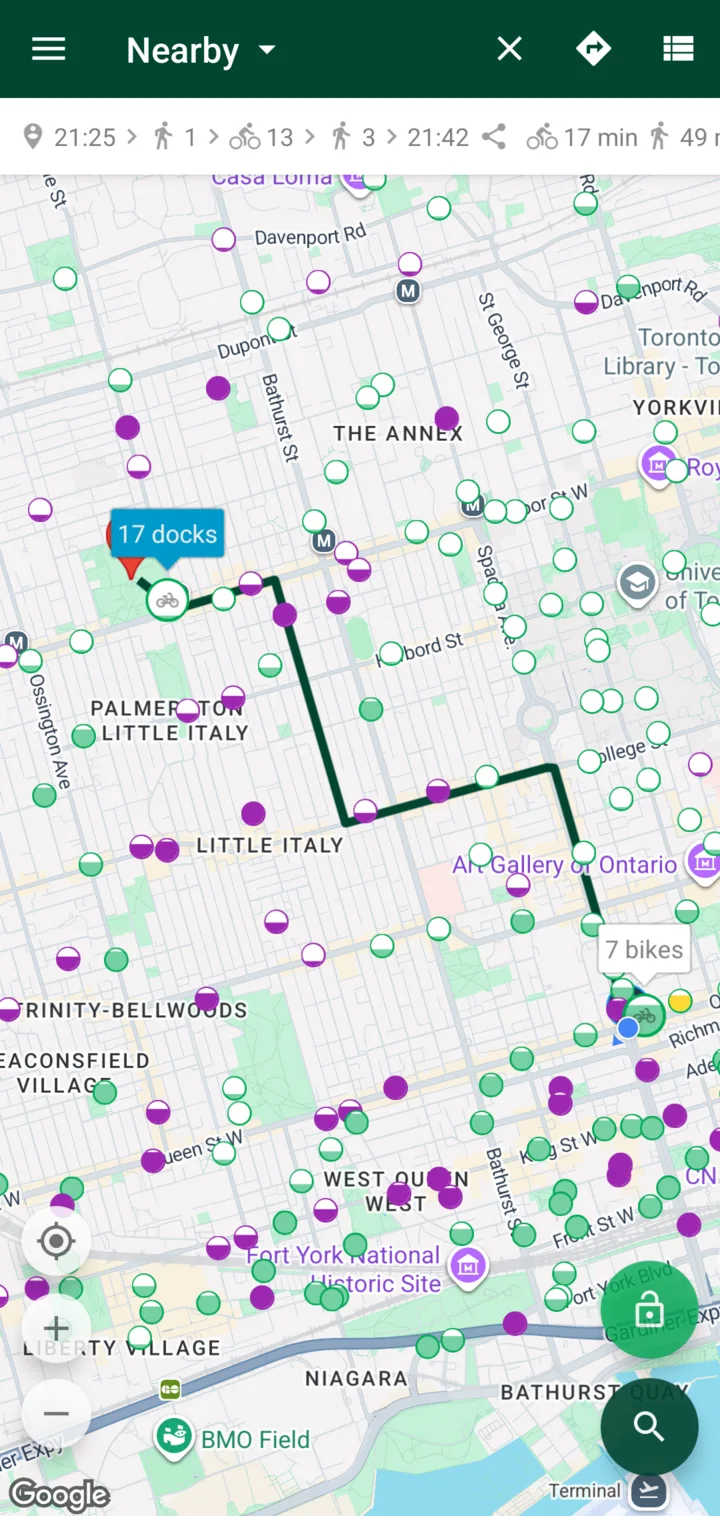
- Pick up near Queen & SpadinaPickup has 7 bikes · 1 min walk
- Spadina Avenue Bike laneNorth
- College Street Bike laneWest through Little Italy
- Palmerston Boulevard Quiet streetNorth, tree-lined, up to Bloor
- Bloor Street WestA short stretch west to Christie
- Dock at Bloor St W / Christie StDropoff has 17 docks · 3 min walk
Cycle Now takes Spadina north and College west. Both have bike lanes, so it stays on them. Then it turns up Palmerston Boulevard, which is exactly the kind of street I mean. Tree-lined and quiet. It carries you right up to Bloor, and the dock at Christie is a short hop from there.
That's the whole idea. Bike lanes where the big streets have them. Side streets where they don't.
Did it cost me time?
This was the part I was worried about. A quiet route is only worth it if it doesn't turn a quick ride into a long one.
So I tested it. Seven pairs of Toronto stations, quiet route against the direct route.
None of them took longer. The worst one added 3.1% to the distance. And three of the seven came out identical to the direct route. The quiet way and the fast way were already the same street.
Seven trips isn't a study. But it matched what I'd felt on the bike: side streets first, usually about the same time.
What changed for me
I didn't expect a routing setting to change my habits. It did.
I ride more. Trips I used to hand to the TTC, I take on a bike now. Trips I used to skip, I take.
I arrive calmer. There's a difference between getting somewhere and getting somewhere with your heart still pounding from the last close pass. I notice it most at the end of the day.
The quiet street was always one block over. I just needed something to point me to it.
And I feel safer. Not invincible. You still pay attention, and you still cross big streets. But when most of a ride is on calm streets and bike lanes, the whole trip feels different.
The biggest change is harder to measure. The bike stopped being something I used only when the route was easy. It became the default. Neighbourhoods I used to rush through on the way to somewhere else, I now ride through on purpose. It opened up a new habit for me, and I didn't see it coming.
Update: now it talks you through the turns
Added Sep 24, 2026. Quiet routes fixed where to ride. Following them was the next problem. Stopping at every corner to check the map isn't very calm either.
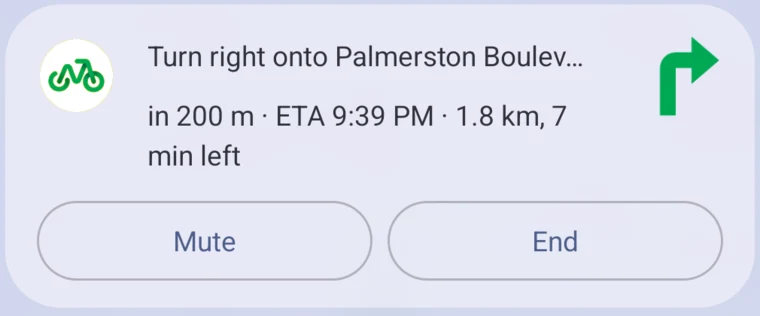
So Cycle Now now does turn-by-turn navigation, in Toronto. Spoken turns, the next turn in your notifications, and a buzz on your watch. Your eyes stay on the street.
If you ride Bike Share Toronto, give quiet routes a try. They're on by default. Plan a trip between two stations and see where it takes you. I think you'll find a few streets you didn't know were there.